December 4th 2025
How trees, soil, and streams connect
Construction is underway along West Creek. White boxy stations are appearing, wells are being drilled, and the trees are being plugged in. What? These stations are part of a long-term research project by the Ecohydrological Systems research group (ECOHYDROS), led by Geneviève Ali, a professor in McGill University’s Earth & Planetary Sciences and Geography departments.
Installed over the course of the summer, these stations collect valuable data to build a first-of-its-kind understanding of the small creek that winds along the yellow trail and the boardwalk.

Geneviève Ali measures a tree before installing a sap flow sensor (photo: Alex Tran)
What is this project about?
The project centres on creating a long-term dataset for multi-dimensional hydrologic connectivity, or in simpler terms, how water flows in, out, and between streams, soil, trees, and the air. As Geneviève Ali explains, this dataset will help us better understand how forest hydrologic systems work.
Collecting data over many years, as planned in this project, will likely confirm but also challenge long-held beliefs about the role of trees in moderating the movement of water through soil, for example. This, in turn, will give us new insights into how to better protect and manage forests.
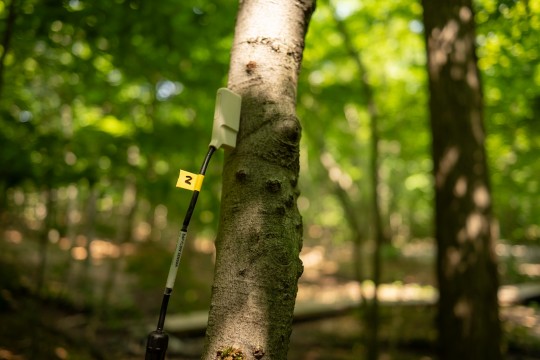
A sap flow sensor installed in the trunk of a beech tree (photo: Alex Tran)
A closer look at the field setup
The field assistants this summer had a chance to meet with ECOHYDROS on one of their major installation days. When they arrived, the area beside the spring had been transformed into a web of wires, solar panels, and what looked like electrical outlets plugged into the trees.
The setup included three groundwater wells in the riparian zone beside the creek, a soil moisture profiler buried into the ground, several trees equipped with sap flow sensors and protected by reflective material, and a data logger that handles measurement and control, powered by a battery and a solar panel.
The groundwater wells reveal how close the water table is to the surface, while the soil profiler tracks soil temperature, moisture, and salinity down to one metre. Most intriguing are the sap flow sensors, which measure the moisture inside each tree and the direction the sap is moving. All of the instruments record data every 15 minutes.

Photo: Alex Tran
Connecting the dots
Tracking sap flow over long periods is one of the best indicators of transpiration, the water that trees essentially “sweat” through their leaves. In forested landscapes like Gault, transpiration, combined with evaporation, is the main pathway through which water is lost to the atmosphere.
Even though transpiration is a well-studied process, including in major forests systems like the Amazon, it remains surprisingly difficult to measuring how much water is actually lost. There is also still much scientists don’t know about transpiration in shoulder seasons (spring and fall) or when they are under stress from very dry or very wet conditions.
By connecting measurements of streamflow, soil moisture, soil temperature and salinity, groundwater levels, and transpiration rates via sap flow, this project will offer a level of detail on how water moves through the forest that is rarely achieved in hydrologic studies.
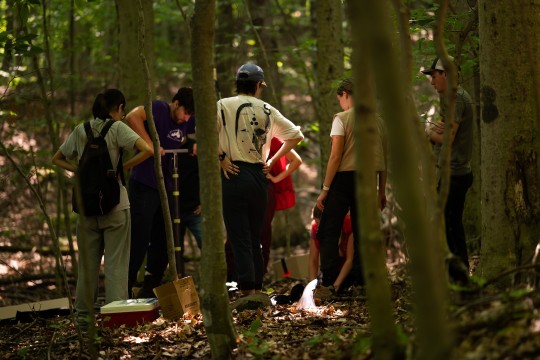
ECOHYDROS team members (Liya, Olivier, Seonaid, Alina, Cléa, Florence, and Liam) digging a well near the spring (photo: Alex Tran)
How will this impact you?
Hydrology is all around us: under our feet, along the roads we travel, and flowing through our natural spaces. With this project and the long-term database it produces, the ECOHYDROS group will be able to compare how water moves through intact forest systems versus more disturbed landscapes, such as rivers running through farmland or residential areas. Understanding these differences will help reveal how land use influences water movement.
This research is especially valuable for the Mont Saint-Hilaire area, which will be used as a reference point for watercourses in the broader Riverlieu River watershed. The more we understand how water travels through through our landscapes, the better we can identify the areas, plant communities, and natural processes that most need protection or restoration. Ultimately, this knowledge supports cleaner, healthier rivers, for both people and wildlife.
Samuel Massey
Field Operations Assistant in 2024 and 2025
Gault Nature Reserve